By:
Sherry Eckholm
September 21, 2026
Detroit is a very specific case study where design seems inseparable from the story of the place itself. I was reminded of that recently during a weekend in Detroit for Detroit Month of Design, where I had the opportunity to participate as a team facilitator for Design Jam, a fast-paced design sprint centered on adaptive outdoor recreation.
I went expecting the Design Jam experience to be the highlight of the trip. It absolutely was, but what I didn’t anticipate was how much the rest of the weekend would reinforce the same ideas about design, innovation, resilience, and human ingenuity.

One of our first stops was Cars at the Station, held on the grounds of Michigan Central. The event brought together an almost overwhelming collection of vehicles, automotive culture, technology, and mobility innovation. Now in its third year, Cars at the Station drew more than 18,000 people over two days.
The scale was incredible. Everywhere I looked was another example of automotive design, engineering, craftsmanship, or simply personal expression. Historic cars, contemporary cars, customized cars, vehicles that represented entirely different eras and philosophies of what transportation could be. I kept taking pictures and eventually realized there was no way to capture it.
What stayed with me wasn’t one particular vehicle. It was the feeling of seeing so much of the legacy of Detroit automotive innovation assembled in one place. You could almost trace generations of ideas about technology, performance, materials, manufacturing, aesthetics, and culture simply by walking through the crowd.
And then there was the backdrop.
Michigan Central Station may have been even more affecting than the cars.
The station opened in 1913, closed in 1988, and sat vacant for more than three decades before Ford acquired it in 2018. Following a six-year restoration, it reopened in 2024 as the centerpiece of the Michigan Central technology and cultural campus.
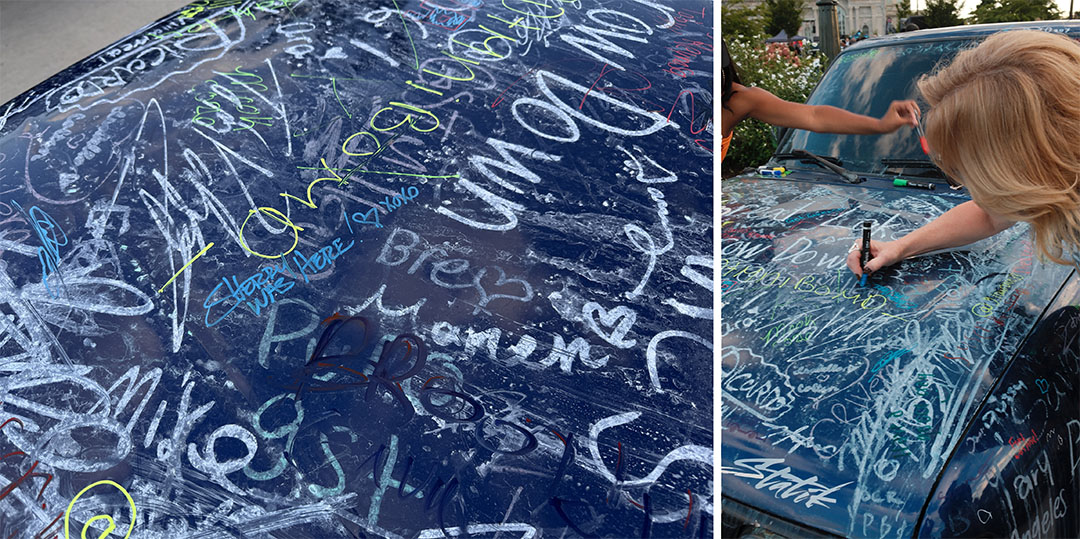
Walking inside is hard to describe. The restored architecture and materials are beautiful, but what made the building so powerful for me was that its difficult years haven’t been erased. Portions of the graffiti created during the decades when the station stood abandoned were intentionally preserved.
You move from these beautifully restored, monumental spaces into areas where the marks of young graffiti artists still cover the walls. Many artists used abandoned places like Michigan Central as spaces to develop their craft, and some went on to significant careers in Detroit’s mural, public art, and commercial design communities.
This is just the type of juxtaposition that inspires design. The graffiti, the grand architecture, the archival photographs showing the building in near ruin, and then the painstakingly restored public spaces all coexist. The before-and-after photographs are almost unbelievable. Rather than presenting a perfectly scrubbed version of history, the building allows you to see its entire arc.
For someone who spends a lot of time thinking about products, brands, and how things evolve, I found that incredibly compelling. The building doesn’t pretend its story was linear.
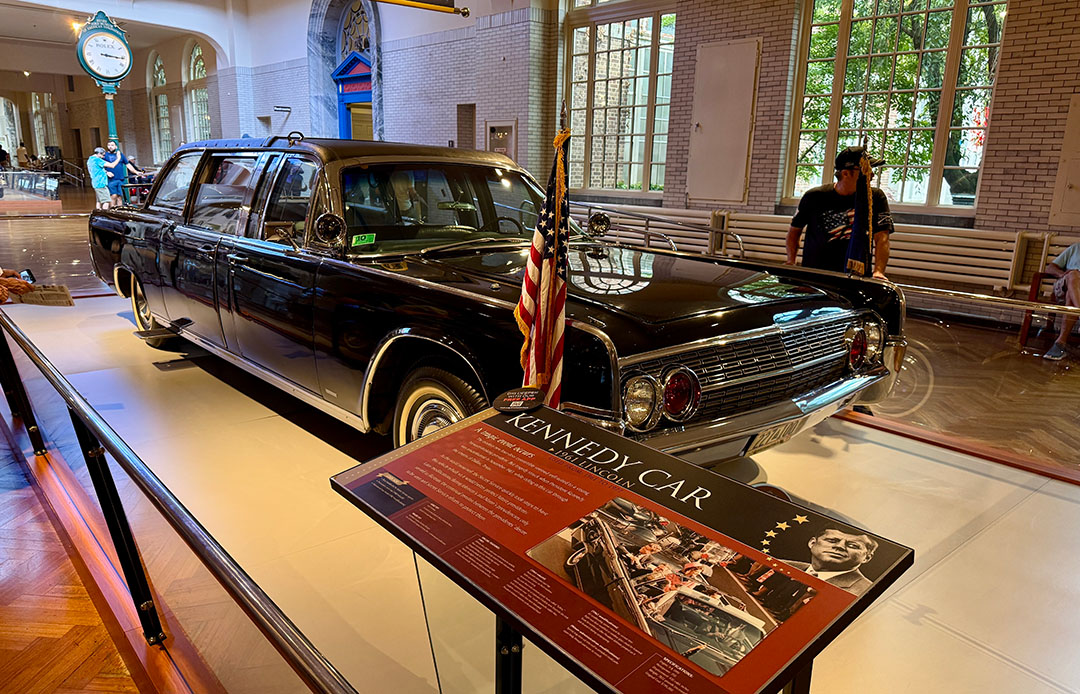
I also squeezed in a visit to the Henry Ford Museum of American Innovation, although calling what I did a “visit” may be generous. The museum is enormous and we had roughly an hour.
First, the Presidential Vehicles collection. Seeing the actual 1961 Lincoln Continental that John F. Kennedy was riding in when he was assassinated is sobering. Nearby is the 1972 Lincoln used by multiple presidents, including Ronald Reagan, who was getting into it when he was shot in 1981 before the car carried him to the hospital.
Next, Buckminster Fuller’s Dymaxion House. If there is an artifact made for designers to obsess over, this might be it.
Conceived as a lightweight, efficient, mass-producible “house of the future,” Fuller’s circular aluminum home challenged almost every convention of residential architecture. The structure hangs from a central mast and was conceived using ideas drawn from aircraft and automobile manufacturing. The example at The Henry Ford is the only surviving prototype.
It was designed in the 1940s, yet you stand inside it thinking about questions we are still asking today: How much material do we actually need? How should things be manufactured? Could housing be more efficient, adaptable, affordable, and sustainable? What happens when you stop accepting the existing typology as a given? These are questions designers never really stop asking.
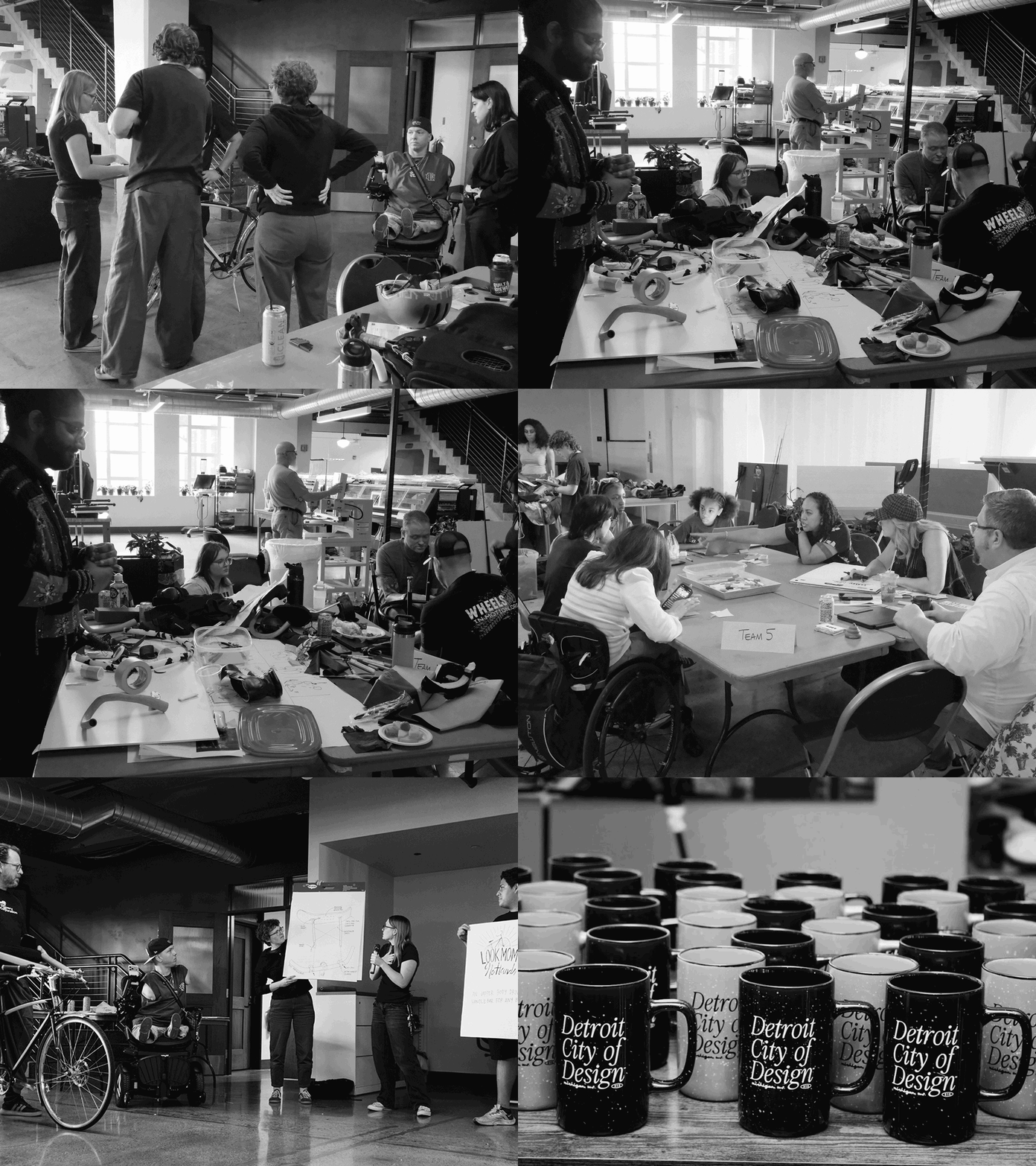
Saturday shifted the weekend from observing design to doing it. Design Jam is a human-centered, fast-paced design sprint that brings interdisciplinary teams together to create and prototype adaptive outdoor recreation concepts with and for people with disabilities.
As a facilitator, my job wasn’t to arrive with the answer. It was to help a team move through exploration, ideation, collaboration, and prototyping, while making sure different voices were heard, creating room for people to contribute, connecting ideas, and helping translate those ideas into tangible concepts.
That is familiar territory for those of us who work in human-centered design, but Design Jam compressed the process into a single intense day.
The design prompts themselves ranged across skiing, fishing, running, cycling, and kayaking, examining challenges such as transferring into adaptive ski equipment, limited grip strength, joint stability, upper-limb differences, physical fatigue, and the complexity of handling outdoor equipment. The point wasn’t to magically “solve accessibility” in a day. It was to listen closely, question assumptions, put ideas into physical form quickly, learn from one another, and recognize where thoughtful design can remove friction that many of us never notice.
For me, this part of the weekend was also personal. My daughter is part of the limb-loss community, so I have had a front-row seat to something designers should always remember…people adapt extraordinarily well. Often, it is the products, environments, and systems around them that have failed to adapt. This is a distinction that matters.
Inclusive design is not simply about creating a special version of an existing product for a narrowly defined group of people. At its best, it asks us to reconsider the assumptions embedded in the original product in the first place. And very often, solving for a wider range of human experiences leads to better design for everyone.
The theme of this year’s Detroit Month of Design was “Design Moves the Future,” with more than 100 events across the city focused on how designers are solving problems, building resilience, and pushing what is possible.
After the weekend, that phrase felt remarkably fitting.
A century-old train station restored without erasing its scars. Generations of automobiles showing the evolution of mobility. A 1940s house proposing an entirely different way to manufacture shelter. And teams of people sitting around tables with cardboard, fabric, sketches, prototypes, and lived experience asking, How Might We make this work better for someone?
Very different expressions of design, but all connected by the same impulse. Observe what exists. Understand what matters. Question what has been accepted. Then make something better.
A huge thank you to Kevin Gilboe, Design Core Detroit, the College for Creative Studies, ISAIC, the City of Detroit, and everyone who put so much energy into making Design Jam possible.
I came to Detroit to help facilitate a design sprint. I left with a pretty powerful reminder of why we do this work in the first place.
Meet Sherry: a trusted strategist and process pro driving high-value innovation. With years of leading cross-functional teams and commitment to design principles, she's your secret weapon to business growth. Genuine and principled, she crafts impactful experiences, unveiling fresh business models and new value propositions informed by her broad corporate, consulting, and venture settings background. Her superpower lies in maintaining a panoramic perspective, recognizing new avenues for growth, and creating actionable roadmaps enabling our clients' market success.
Sherry fuels her Wisconsin adventures with family and friends, exploring lakes, tapping maple trees in spring, and enjoying every moment of Madison's summer.
And Sherry's next-level inspiration? Her unwavering belief that design will change the world for the better.

Previous
Next

Mobility
Culture
Innovation


.png)


